How It All Fits Together
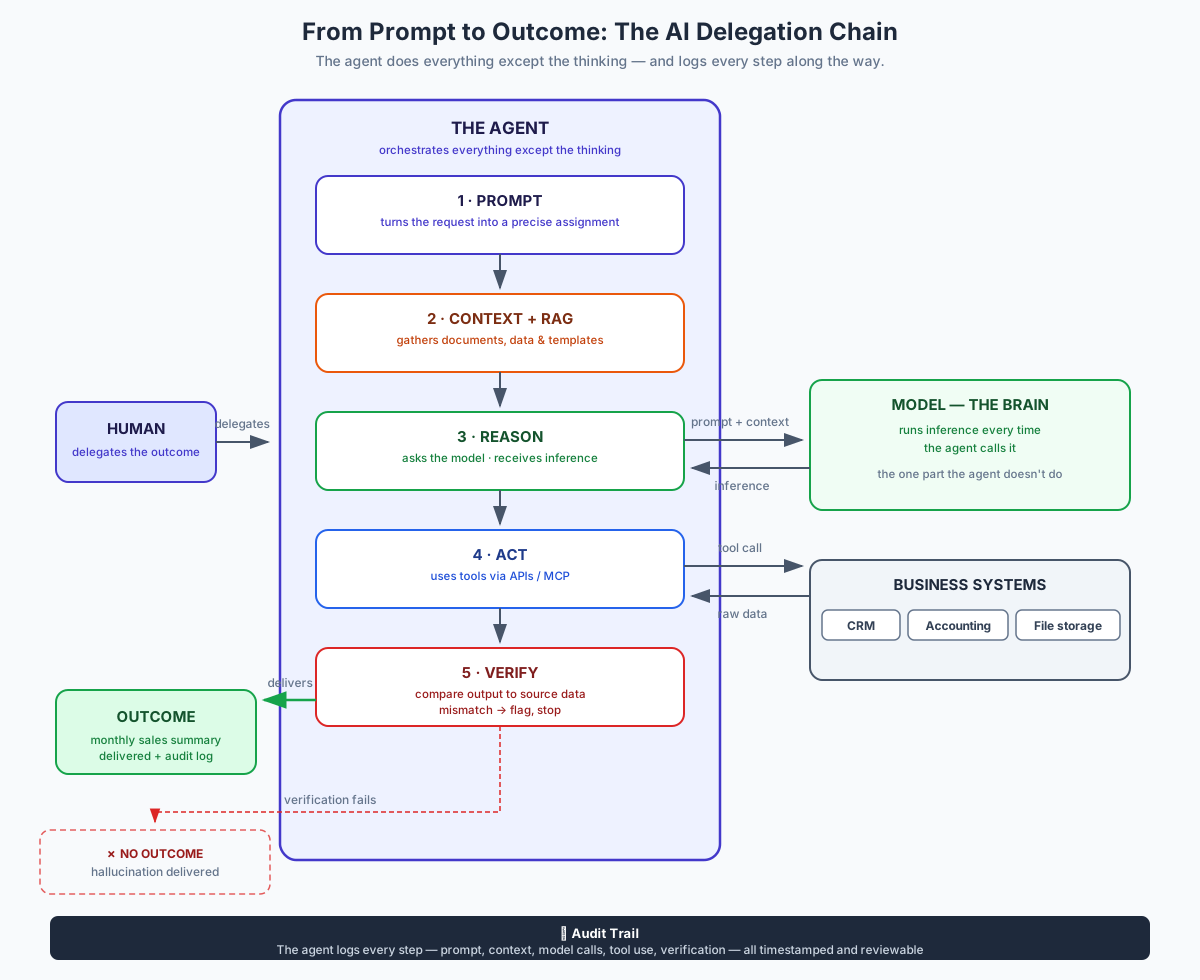
Every term in this glossary is one part of a single chain — from your request to a verified result. The agent orchestrates everything except the thinking.
Core Concepts
5 termsAI (Artificial Intelligence)
Broadly, software that can perform tasks that typically require human intelligence—such as recognizing patterns, solving problems, or understanding language.
Model (LLM)
The "brain" of the operation (e.g., Llama, GPT, Claude). A Large Language Model (LLM) is a program trained on massive amounts of text to predict and generate human-like language.
Inference
The actual process of the AI "thinking." When you hit enter, the model performs "inference" to calculate the most likely next words in its response.
Token
The unit of text a model reads and writes — roughly ¾ of a word. Pricing, context limits, and speed are all measured in tokens; a 2,000-word document is about 2,700 of them.
Context Window
How much text a model can consider at once — its working memory for a single task. Exceed it and older content falls off the edge; stuff it with noise and quality drops (see Context Mastery in the Power User track).
Everyday Interaction
5 termsPrompt
The specific instruction, question, or input you give to an AI. Think of it as the "assignment" you are giving your AI co-worker.
Context
The "background information" the AI is currently looking at. This includes the previous messages in your chat and any documents you have uploaded for it to read.
System Prompt
The standing instructions that shape every response before you type a word — role, tone, rules, tools. You set it once in the agent’s configuration, and shape it every time you state a preference in chat.
Temperature
A dial for randomness. Low (0–0.3) gives steady, repeatable answers for data work; high (0.8+) gives varied, creative ones for brainstorming. When output must be consistent, turn it down.
Multimodal
Models that handle more than text — images, audio, screenshots, documents in one conversation. Practical test: hand it a photo of a whiteboard and ask for the action items.
Agents & Tools
4 termsAgent
Unlike a basic chatbot that just talks, an Agent can actually *do* things—like searching the web, reading your files, or updating a calendar.
Agentic (AI)
Software that plans and acts across multiple steps — calling tools, checking results, correcting course — instead of answering once. The practical test: give it an outcome, not a question, and see whether it builds the path.
API (Application Programming Interface)
A digital bridge that allows two different software programs to talk to each other. For example, Hermes uses an API to "talk" to Telegram or Nextcloud.
MCP (Model Context Protocol)
A standardized way for AI agents to connect to external tools and data. It ensures that different tools can be added to an agent without needing to write custom code for every single one.
Knowledge & Customization
3 termsRAG (Retrieval-Augmented Generation)
The process of giving the AI a specific document to read *before* it answers. It's like giving the AI an "open book test" instead of relying on its memory.
Embeddings
A way of turning text into coordinates so “similar meaning” becomes “nearby points.” It’s how search finds the right document even when the words don’t match — the retrieval half of RAG.
Fine-tuning
Extra training on your own examples that specializes a general model — its voice, format, domain. Costly to do well, cheap to imitate: most “custom AI” is prompting plus retrieval, which is usually fine.
Trust, Privacy & Limits
6 termsHallucination
When an AI confidently provides an answer that is factually incorrect or completely made up. This is why "Trust but Verify" is a core rule of the Academy.
Knowledge Cutoff
The date past which a model’s built-in knowledge stops. Anything later must come from search, your files, or a tool — which is why a confident answer about last week deserves a source.
Guardrails
The checks around a model — allowed tools, review steps, output validation — that make its output trustworthy for a specific job. The model supplies ability; guardrails supply reliability.
Sovereign AI
Running AI where you control the model, the data, the infrastructure, and the rules — instead of renting intelligence from a provider on their terms. See the Sovereign AI track for the full walkthrough.
ZDR (Zero Data Retention)
A provider guarantee that nothing is kept after your prompt is processed. Important: this is often a setting you must enable or a contract you must sign — never assume it is the default.
Data Residency
The answer to "where in the world is my data stored?" Some industries and contracts require data to stay in a specific region or building — a key reason organizations choose sovereign AI.
Hardware & Architecture
4 termsMoE (Mixture of Experts)
A model built from many specialized “expert” sub-networks, of which only a few activate per token — the capacity of a huge model at the compute cost of a much smaller one. The trade-off: every expert sits in memory even when idle, which is why MoE models favor machines with lots of RAM or unified memory.
Local Inference
Running the AI "brain" on hardware you own — a server in your office or a private cloud instance — instead of sending prompts to an outside service. Your prompts never leave your network.
Tensor Cores
Specialized circuits inside a modern GPU built for one job: the matrix math AI runs on. Generic GPU cores can do it; tensor cores do it far faster and more efficiently, which is why training and local inference prices and speeds hinge on them. Practical test: when a provider quotes GPU specs, look for tensor core counts, not just “GPU count.”
Unified Memory
One shared pool of RAM that both the CPU and GPU read and write directly, instead of separate CPU and GPU pools shuttling copies back and forth. Big win for local AI: a machine can run larger models than its discrete VRAM alone allows, because usable model size is governed by total unified RAM, not a fixed VRAM cap.
Knowledge Check
Three quick questions to test yourself. Nothing is submitted; this is just for you.
1. A token is…
2. Retrieval-augmented generation (RAG) means the AI…
3. The context window is…